September served as a reminder that interest rates still matter. For the first time in more than three years, the Federal Reserve raised interest rates, pushing Treasury yields sharply higher and renewing concerns about borrowing costs across the economy. At the same time, oil prices surged amid ongoing geopolitical tensions, adding another layer of uncertainty for investors.
While the headline decline in stocks was modest, the story beneath the surface was far more dramatic. A small group of large technology and AI-related companies continued to hold up well, while much of the market struggled under the weight of rising rates.
Markets
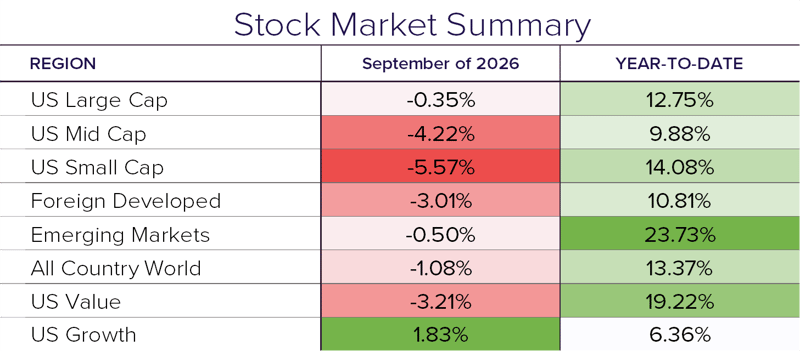
Most equity markets moved lower in September. U.S. large-cap stocks declined just 0.4%, but that relatively mild result masked significant weakness elsewhere. Mid-cap and small-cap stocks fell 4.2% and 5.6%, respectively, while foreign developed markets declined 3.0% and emerging markets slipped 0.5%. Growth stocks gained 1.8%, while value stocks fell 3.2%.
The sharp differences across market segments reflected increasingly narrow participation. Technology and Communication Services were the only sectors to post gains during the month, while nearly every other area of the market moved lower. Financials, Materials, Real Estate, Utilities, Consumer Discretionary, and Industrials all declined between 4% and 7%.
The result is a market that appears healthier at the index level than it does underneath the surface. According to YCharts, roughly 60% of S&P 500 companies remain at least 20% below their all-time highs despite the index itself remaining near record levels. Rather than broad participation, a relatively small group of mega-cap companies continues to account for a disproportionate share of overall market returns.
Rates and the Economy
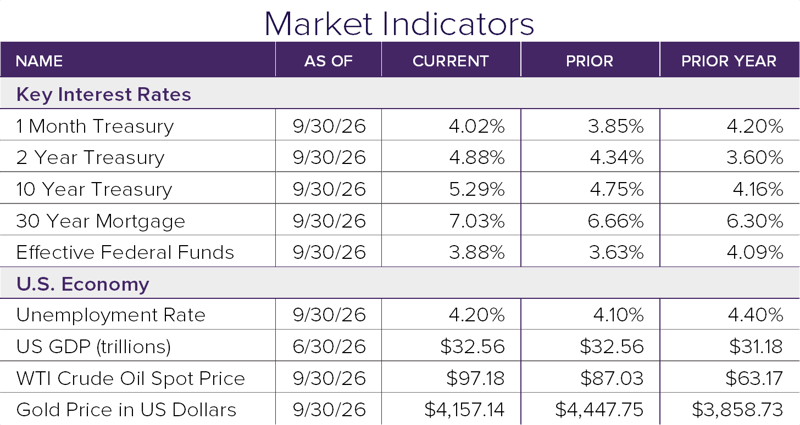
The bond market experienced one of its most significant moves of the year. Following the Federal Reserve's rate increase, Treasury yields climbed sharply across the curve. The 10-year Treasury yield rose to 5.3%, its highest level in more than two decades, while mortgage rates moved back above 7%.
Higher yields weighed on bond prices, with the Bloomberg U.S. Aggregate Bond Index declining 2.6% during the month. Rising borrowing costs also create challenges for interest-rate-sensitive areas of the economy, including housing, commercial real estate, and smaller companies that rely more heavily on debt financing.
Meanwhile, oil prices added further pressure. Brent crude rose approximately 25% during September as markets responded to continued instability in the Middle East. Even so, inflation readings remained relatively stable, leaving investors to balance resilient economic growth against higher energy costs and rising interest rates.
Looking Ahead
As markets enter the fourth quarter, investors will be watching whether higher rates begin to slow economic activity and whether inflation remains contained despite rising energy prices. Equally important will be whether market leadership broadens beyond a handful of large technology companies.
Today's market continues to reflect significant differences in performance across sectors, asset classes, and individual securities. With higher bond yields and a broader opportunity set available across fixed income, equities, and alternative strategies, investors have more choices than they have had in years. Diversification may become an increasingly important consideration rather than focusing solely on headline index returns.