October’s modest headline decline concealed one of the sharpest changes in market leadership in years.
Markets
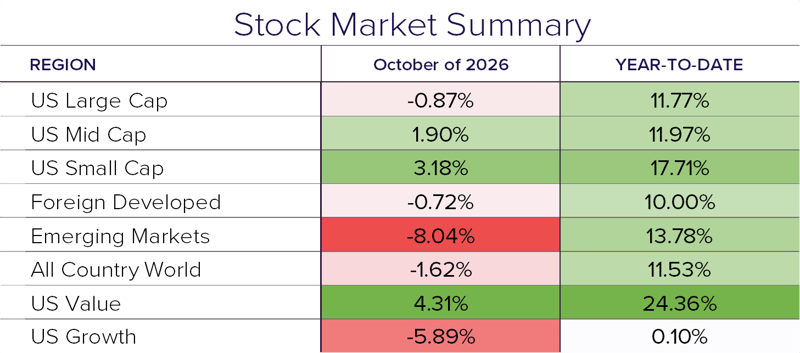
The S&P 500 declined 0.9% in October, but the weakness was concentrated in large growth and AI-related companies. U.S. value stocks gained 4.3%, while growth fell 5.9%. Mid-cap and small-cap stocks also advanced 1.9% and 3.2%, respectively. More than 70% of S&P 500 companies finished higher, showing that the month was more a rotation within equities than a uniform retreat.
The clearest evidence was the equal-weighted S&P 500, which gained 5.0% while the traditional market-cap-weighted index declined. The nearly six-percentage-point performance gap was the equal-weight index’s largest monthly outperformance since April 2009. Energy gained 14.0%, while Consumer Staples, Utilities, and Health Care each rose roughly 10% or more. Information Technology fell 6.8% and Communication Services declined 15.1%. Alphabet, Meta, and Netflix are included in Communication Services rather than Technology, which helps explain why that sector experienced the month’s largest decline.
The pressure on growth stocks reflected increasing scrutiny of artificial-intelligence investment. Several historically cash-generative companies, including Amazon, Alphabet, and Meta, have seen capital spending rise above operating cash flow as data-center and computing investment accelerated. The central question is shifting from whether AI demand is strong to whether the scale and financing cost of today’s investment will produce sufficient future returns. Foreign developed stocks declined 0.7%, while emerging markets fell 8.0%, partly reflecting weakness in technology-heavy Asian markets.
Fixed Income and the Economy
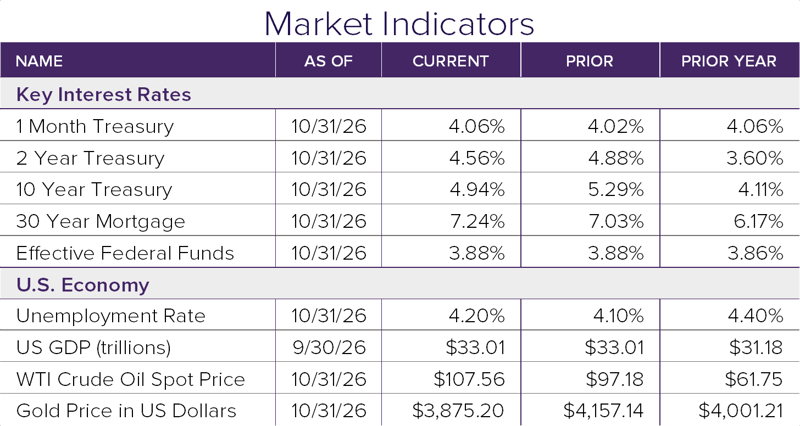
Bonds provided a useful counterweight. The 10-year Treasury yield fell 35 basis points to 4.94%, reversing part of September’s sharp increase, and the U.S. Aggregate Bond benchmark gained 2.4%. Treasury yields moved lower across most maturities as government bonds regained some of their traditional defensive appeal. Investment-grade corporate bonds also benefited from lower yields, although credit spreads widened as investors became more selective, particularly around AI-related financing.
Economic data remained mixed. September payrolls increased by 29,000 and unemployment edged up to 4.2%, while inflation accelerated to 3.7%. The Federal Reserve held its policy rate at 3.75% to 4.00% following September’s increase, with two policymakers favoring another hike. Economic growth remained resilient, leaving the Fed to balance softer hiring against renewed inflation pressure.
Looking Ahead
October’s rotation has carried into a volatile start to November. Following the midterm elections, selling pressure has intensified across technology, semiconductor, and AI-related companies as investors reassess the pace of data-center investment and the potential for regulatory changes. For Long term investors, sharp rotations in investment sector leadership over the past two months, along with significant changes from mid-term elections in Congressional leadership which will switch places two months from now, provide another reminder of the value of diversification across styles, company sizes, sectors, and asset classes.